
What Juneau County Property Tax Records Show
A tax record here is rarely a single document. Juneau County property tax records draw on the assessment system, the local treasurers, and the county treasurer. The public Catalis portal offers a guest route. Guest Sign In opens tax parcel data, though the portal warns the information may be incomplete or out of date. The DOR's 2025 roll report is another useful example.
| Field | What It Shows | Where |
|---|---|---|
| Parcel and municipality | Local parcel, description and taxing-jurisdiction context. | Catalis assessment search and DOR roll report |
| Land, improvement and total | Separate assessed-value components for the parcel. | Assessment record; exact guest-card labels not verified |
| Equalized value and ratio | Municipality-level comparison with assessed totals. | Wisconsin DOR statistical reports |
| Tax bill and payment | Charges, installments and payment status for a tax year. | Local treasurer or county treasurer route |
| Delinquency or special charge | Unpaid balance or charge to confirm with the bill custodian. | Treasurer; complete online delinquency index not located |
The 2025 Juneau report from the DOR lists each municipality, the local parcel, description, school and special-district fields, acreage, land, improvement, and total values, plus an aggregate ratio. It is assessment context, not a title document. Nothing in it proves ownership. Parcel cards differ. Catalis exemption fields and tax-payment history vary, so confirm a number in the live portal or with the treasurer before relying on it.
Looking Up a Juneau County Tax Bill
Catalis LandNav identifies the parcel and its assessment year. That result is not a payment receipt. It is not a live balance either. The bill's municipality and collector decide where to check installments, penalties, credits, and payment status. Keep the parcel number and tax year with your question so an office can locate the correct account.
- Search the Catalis real-estate portal by property address, owner, parcel number or legal description, and select the tax year you need.
- Read the official bill for the taxing municipality, billed owner, parcel description, installment directions and payment office.
- Ask the municipality's treasurer about its initial collection and the Juneau County Treasurer about a later installment or county-held balance, as directed by the bill.
- For an unpaid or disputed amount, request the current account history and any official notice from the responsible treasurer; do not infer a completed sale from a delinquency entry.
- Assessed value
- The municipality's value on the assessment roll; it is a tax input, not the amount due or a recent sale price.
- Levy and tax rate
- Local taxing needs and district rates are applied to the taxable assessment; use the bill's itemization for the actual charge.
- Credits and exemptions
- Programs can affect tax treatment, but a complete current Juneau County eligibility list was not verified. Confirm the parcel's status with the assessor or municipality.
- Delinquent tax
- An unpaid amount that should be confirmed with the treasurer responsible for that tax year; a public account entry is not by itself proof that a parcel was transferred.
Juneau County's Catalis Tax Search
Guest Sign In is the doorway for tax parcel data. The portal points visitors there first. In the real-estate form, pick a municipality and a tax year. Then search by parcel number or by address. The form keeps Property Address and Mailing Address separate. It accepts a single year or a range. Write the tax year down. A number from one roll is not automatically the current year's value or bill.
The property-search route covers the rest. The form itself offers years 2024 and 2025, with municipality choices including Elroy, Mauston, and New Lisbon. A legacy GCS site still posts a parcel-format notice, but the county's new Catalis landing page is the current guest route.
| Tax Year | Single year or a range; the captured search configuration showed 2024-2025. |
|---|---|
| Municipality | Choose the town, village or city code attached to the parcel. |
| Parcel # | Single, range or list; preserve the leading zero required in the legacy notice. |
| Address mode | Select Property Address or Mailing Address to find the intended record. |
| Owner and status | Search last name/business, first name and current/former owner status. |
The Juneau County Catalis portal is the guest route. Data there can be incomplete or stale, so confirm any bill balance or payment status with the appropriate treasurer.
Juneau County Assessed and Equalized Values
Assessed value is the local number on a parcel. Wisconsin DOR defines a parcel's assessment ratio as assessed value divided by fair market value. Its assessor guide offers an example. A parcel assessed at $140,000 against a $150,000 market value works out to 93 percent. That ratio describes one parcel. The municipality's assessment level, called an aggregate ratio, compares municipal assessed totals with the DOR equalized value instead.
These measures can move differently. Equalized value lets DOR compare assessment levels across municipalities. It never sets one house's price. The DOR's 2025 county report lists land, improvement, and total values beside local parcel and district fields. Use it for township or city context. Then check the parcel record itself.
Credits and exemptions can change taxable treatment. Juneau County publishes no single eligibility list, and portal exemption fields may vary. Do not assume a credit appears on every parcel, or that an exemption moves a sale price. The DOR aggregate-ratio explanation separates the municipal measure from one parcel's ratio.
The DOR Open Book and Board of Review calendar lists municipal dates, not parcel values.
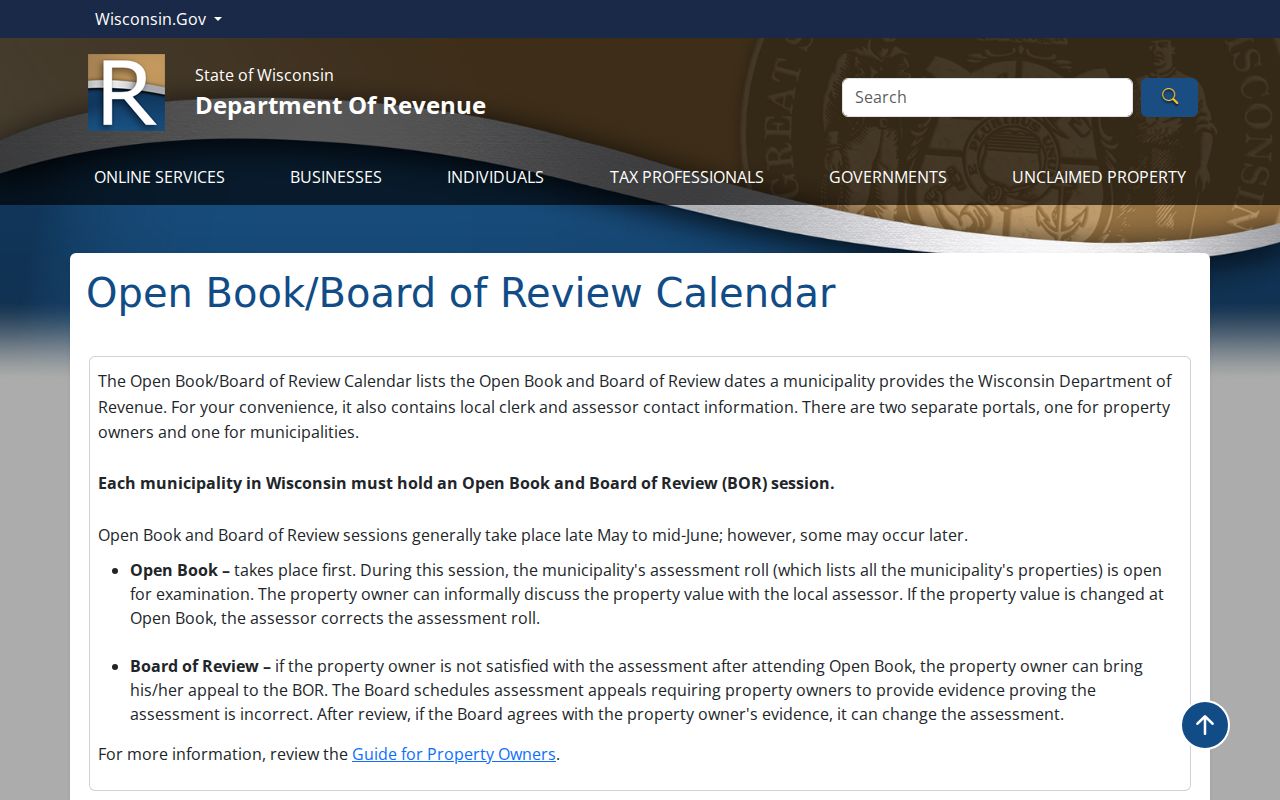
Each municipality sets its own schedule. The calendar tells you when assessment questions can be raised, but it neither shows nor revises a parcel's assessed value.
Juneau County Treasurer Payment Routes
Assessment and collection often sit in different offices. A municipality may take the first installment locally. A later installment can go to the county treasurer instead. Read the payment instructions on the bill and confirm the jurisdiction before sending money. Denise J. Giebel serves as Juneau County Treasurer. Personal-property tax questions belong with the local treasurer.
When an online bill falls short, ask the treasurer directly. Have the tax year, parcel, installment, unpaid amount, interest, penalties, and special assessments ready. The county posts no complete delinquency page. There is no universal installment schedule either. Even a vacant lot can carry a tax district and special charges, with no house to search by.
The county portal routes visitors to online services. Its public notice warns that displayed data can lag, so keep the parcel number and bill year and use the office listed on the bill for an official balance or receipt. Never infer delinquency from an assessment value or a land-sale listing.
Appealing a Juneau County Assessment
Wisconsin gives owners two steps to challenge an assessment. Open Book comes first. There the tax roll is open for review. The assessor can talk through the numbers or fix an outright error. If the two sides still disagree, the objection moves to the Board of Review. Each Juneau County municipality picks its own meeting date. Check the DOR calendar for the exact city or town entry before planning anything.
Good evidence makes the case. Recent arm's-length sales work. Errors in the land or improvement data also work, along with a comparison showing unequal assessment. A deed sale price proves a transaction happened. It is not automatically the assessor's market value. Keep the parcel number, sale date, property facts and comparable details in one file. A broad claim that values rose or fell is not enough. It does not show a problem with a single property record.
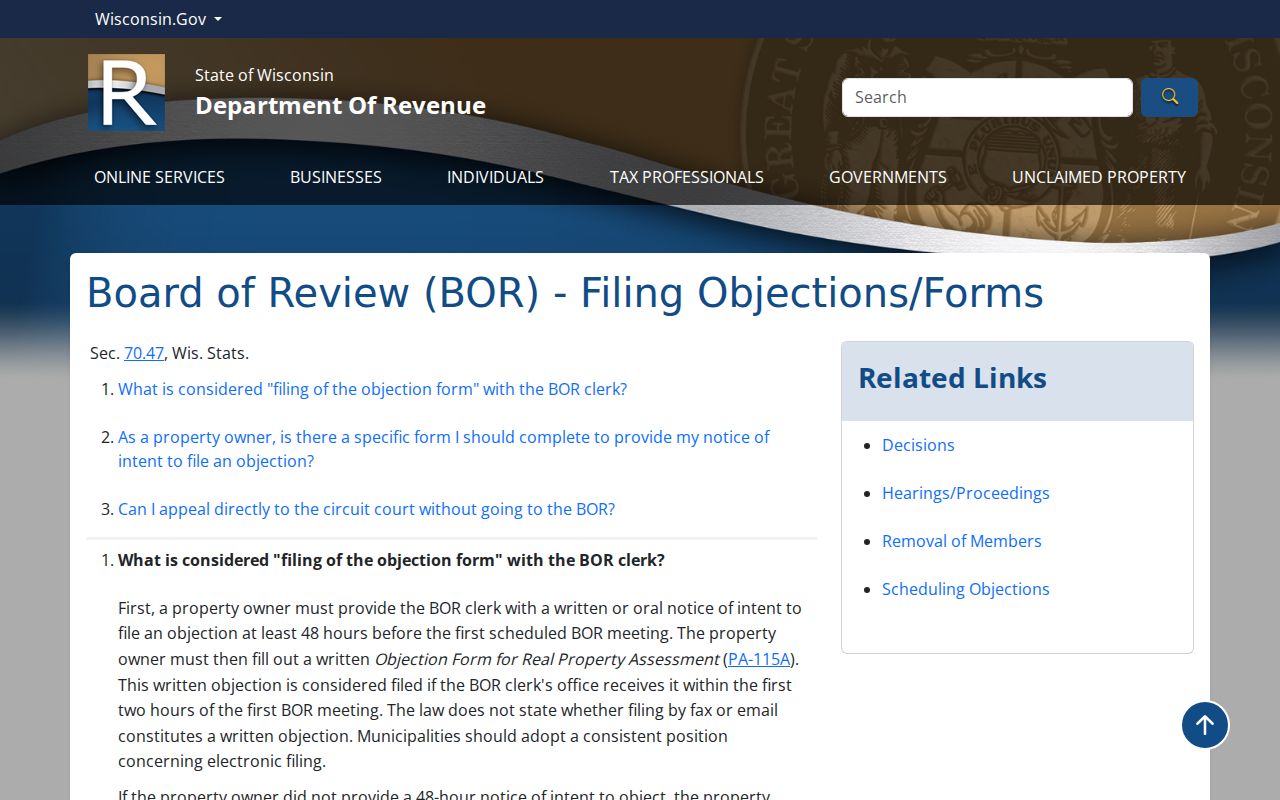
Appeal window. Under Wis. Stat. §70.47, give notice of intent at least 48 hours before the first Board of Review meeting and file PA-115A within its first two hours. PA-813 is the waiver-of-hearing route; use the local notice and DOR guidance to confirm the meeting procedure.
The DOR's PA-115A and 48-hour notice guidance is linked to the objection image below. It walks through the form and the waiver path, though the municipality's posted calendar still sets the local date.
Missed the meeting date? Ask the municipal clerk or assessor when the next review period applies. The DOR calendar usually lists meetings from late May through mid-June, but a revaluation can shift that schedule or force an adjournment and a later reconvening.
Juneau County's 2025 Assessment Roll
The DOR 2025 Juneau County roll report shows the assessment fields. Property research draws on them. Each entry carries the municipality, county, book and page, local parcel number, description, district, acreage, land value, improvement value and total value. It also lists the aggregate ratio. The report is useful for placing an assessment in its municipality. It does not replace a current parcel card or tax bill.
Read the local parcel number and tax year with care. A city property and a neighboring town property can share the same postal city. The two can still fall under different districts and assessment levels. When a number looks wrong, compare the legal description, acreage and the land-improvement split first. Then ask the assessor how the roll was assembled.
The aggregate ratio compares municipalities. It is not a parcel's sale price. Read the DOR 2025 tables and the current portal together. Add the local assessment notice for the full picture.
Juneau County Sales-Ratio Context
Wisconsin DOR announced on March 24, 2026 that final 2025 sales reports were available. The reports are intended for assessors. Those reports contain usable arm's-length sales and assessment-to-sale-ratio analysis. That material shapes how local assessment levels are studied. The detailed sales report sits behind an assessor login. A public parcel search does not expose the same data.
One last-sale amount can mislead. The sale date, property condition, related-party terms or improvements made since closing can all bend the number. Property condition and sale terms vary from parcel to parcel. Compare a set of suitable transactions instead of applying one sale price to a whole neighborhood. Add the municipal assessment ratio to that comparison. For a specific parcel, treat the DOR material as assessment context. Ask the local assessor which evidence the Board of Review will actually accept.
Read the DOR 2026 sales-report notice alongside the aggregate-ratio explanation. Both describe the state's comparison tools, not a Juneau County parcel sale.
Juneau County Delinquent Tax Clues
Delinquent tax data is not an assessed value. Juneau County publishes no complete online delinquency index and no county tax-sale calendar. Start with the treasurer for the parcel. Ask about unpaid installments, interest, penalties, special charges and any sale or redemption status. Then check whether a court action or recorded notice is tied to that same parcel.
The county land-sale page lists properties by township and tax parcel. Each listing includes acreage, minimum bid and maps. A listing is a lead, not a final deed. It also does not guarantee a sale closed. Search WCCA for foreclosure or tax-foreclosure cases and LandShark for a lis pendens, judgment, sheriff's deed, satisfaction or later conveyance.
Tax bills, assessment appeals and market-price questions all lean on related property records. But each is a different calculation. What is a parcel actually worth? Turn to the separate Juneau County property value discussion for that.